
March 15, 2026


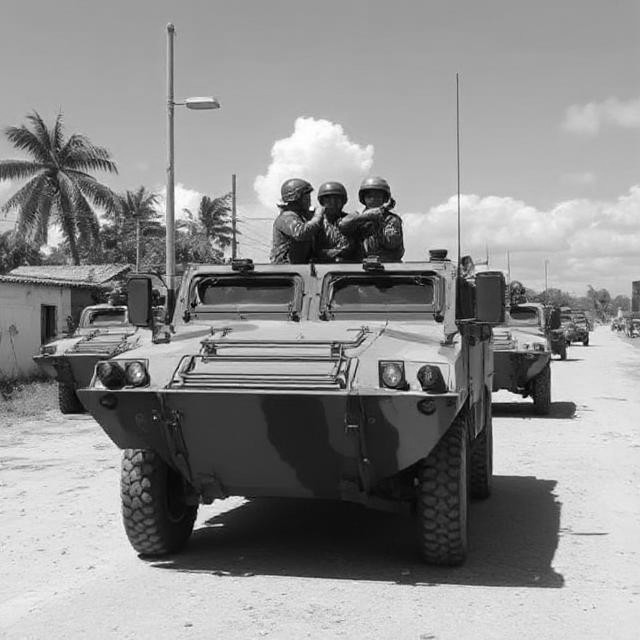
On Saturday, November 8, 2025, Prime Minister Alix Didier Fils-Aimé handed over seven armored vehicles to the Armed Forces of Haiti (FAd’H), in the presence of Presidential Advisor Leslie Voltaire. Behind this solemn gesture—meant to symbolize the revival of national security—lies above all the attempt of a weakened government to mask its lack of concrete results on the ground.
Since taking office, Fils-Aimé had promised to “make the country safe and stable.” Yet reality contradicts his words: violence persists, the population lives in fear, and the government’s security strategy remains vague, improvised, and devoid of real state direction.
Minister of Defense Me Jean-Michel Moïse praised the delivery of the vehicles, describing it as “the first phase of an order for seventeen vehicles” intended to strengthen FAd’H operations. However, these pieces of equipment—costly and largely symbolic—struggle to convince in a context where the army lacks logistics, proper training, and a presence in gang-controlled areas.
Fils-Aimé, maintaining his martial tone, once again promised to “defend the homeland and protect the people.” Familiar phrases, repeated at every official ceremony, but which ring increasingly hollow as the national situation deteriorates and the population loses confidence in his ability to govern.
The handover of the armored vehicles could have been a strong act of sovereignty. Instead, it appears to be a communications exercise—devoid of strategic vision—by a government gasping for relevance in the face of chaos it neither controls nor fully understands.